
On this page14 sections
- Quick picker
- Weather and the sky
- Weight and burden
- Places: holes, rooms and tunnels
- Motion: spirals, loops and waves
- Energy and burnout
- The mind itself
- Recovery and good days
- Well-known metaphors and where they come from
- Talking to someone who is struggling
- Metaphors that can hurt
- How to write your own
- Practice
- Quick answers
The metaphors people use most for mental health picture the mind as weather (“a fog”, “a storm passing through”), as a weight (“carrying it around”), as a place (“a dark hole”, “a bad place”) or as a journey (“recovery is a road, not a switch”). The best one is the one that matches what the experience is actually like for the person describing it, so this page groups real, everyday metaphors by what they say, and shows how to use them with care.
Each metaphor has a short note on what it conveys. There are sections for recovery and good days, for the mind itself, for talking to someone who is struggling, a few well-known metaphors with their sources, the ones that can hurt, and a short practice set. For single conditions there are fuller pages: metaphors for depression, metaphors for anxiety, metaphors for stress and metaphors for grief.
Quick picker
| You want to say… | Try |
|---|---|
| it feels heavy | “a weight on my chest”, “carrying a backpack of stones”, “emotional baggage” |
| I can’t think clearly | “brain fog”, “my head is full of static”, “wading through mud” |
| I feel stuck | “stuck in a rut”, “trapped in a loop”, “spinning my wheels” |
| it’s getting worse | “a downward spiral”, “sinking”, “the walls closing in” |
| I have nothing left | “running on empty”, “burnt out”, “my battery is at 2%” |
| it comes and goes | “waves”, “a storm that passes”, “good days and bad days are seasons” |
| I’m getting better | “coming up for air”, “climbing out”, “the fog is lifting” |
| it needs ongoing care | “my mind is a garden”, “maintenance, not a one-off repair” |
Weather and the sky
Weather metaphors are popular because they say two true things at once: the feeling is real and powerful, and it is not permanent or the person’s fault.
- “There’s a cloud over everything.” – a low mood that dims even good things.
- “The fog hasn’t lifted yet.” – confusion, numbness or slowed thinking.
- “It’s a storm; I’m waiting for it to pass.” – an intense episode that the speaker knows will end.
- “I’m weathering it.” – getting through a hard time without being destroyed by it.
- “You are the sky; the feelings are the weather.” – a teaching image common in mindfulness: thoughts and moods pass across a mind that stays itself.
- “A long winter.” – a slow, grey stretch, often used for grief or seasonal low mood.
- “The sun came out for an afternoon.” – a good moment inside a bad period, which is worth noticing.
More: metaphors about storms.
Weight and burden
- “A weight on my chest.” – heaviness that can also be physical, as many people with anxiety or depression describe it.
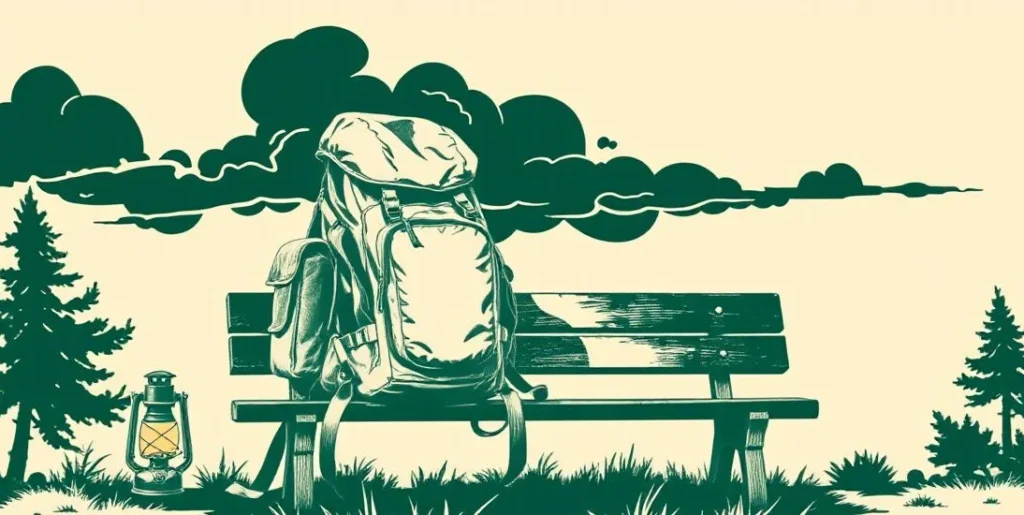
- “I’m carrying a backpack full of stones.” – old worries and hurts that come everywhere with you. Useful because a backpack can be put down, one stone at a time.
- “Emotional baggage.” – feelings from the past that affect the present. Everyday, slightly informal; it can sound like a criticism, so it is gentler about yourself than about someone else.
- “Dead weight.” – the feeling of having no energy to lift anything, even yourself out of bed.
- “The straw that broke the camel’s back.” – a small thing that tipped someone over after a long build-up.
Places: holes, rooms and tunnels
- “I’m in a dark place.” – the most common everyday metaphor for a mental health low. Plain and understood by everyone.
- “A hole I can’t climb out of.” – feeling trapped and too tired to escape.
- “Hitting rock bottom.” – reaching the worst point, often the point where change starts. Common in addiction recovery.
- “The light at the end of the tunnel.” – hope that a hard period will end.
- “The walls are closing in.” – panic or a sense of shrinking options.
- “My world has shrunk.” – fewer places, people and activities feel possible; common in depression and agoraphobia.
- “Living under glass.” – cut off from the world while still seeing it. Sylvia Plath’s novel The Bell Jar (1963) uses the image of a bell jar for exactly this.
Motion: spirals, loops and waves
- “A downward spiral.” – each bad thing makes the next more likely.
- “Spiralling.” – informal, for anxious thoughts that feed each other: “I’m spiralling about the interview.”
- “Stuck in a loop / on a hamster wheel.” – the same thoughts or habits going round without getting anywhere.
- “Waves.” – grief and panic often come in waves; “riding the wave” means letting a feeling rise and fall without fighting it.
- “An emotional rollercoaster.” – fast changes of mood. Everyday and a little worn; avoid it when talking about a diagnosis such as bipolar disorder, where it can trivialise.
- “Treading water.” – managing to stay afloat but not moving forward.
Energy and burnout
- “Burnt out.” – exhausted by long stress, especially at work. The image is a candle or engine that has used up its fuel.
- “Running on empty / on fumes.” – carrying on with nothing left in the tank.
- “My battery is at 2%.” – a modern, light way to say “I need rest”, good in texts and at work.
- “You can’t pour from an empty cup.” – a common saying for why carers need to look after themselves too.
- “Spoons.” – from Christine Miserandino’s “spoon theory” (2003), first written about chronic illness: each task costs a spoon, and you have only so many each day. Many people now use it for mental health: “I’m out of spoons today.”
The mind itself
- “My mind is a garden.” – it needs regular care; weeds (unhelpful thoughts) come back, and that is normal.
- “My head is a browser with fifty tabs open.” – overload and racing thoughts.
- “Static” / “white noise”. – background anxiety or the blank feeling of not being able to think.
- “An inner critic.” – the harsh voice inside that judges everything. Naming it as a separate voice helps some people argue back.
- “A pressure cooker.” – feelings building up with no release; “letting off steam” is the release.
- “Wiring.” – “my brain is wired differently” is a common, neutral way to talk about ADHD, autism or anxiety.
Recovery and good days
Recovery metaphors work best when they allow for setbacks. A straight line (“I’m cured”) rarely matches anyone’s experience.
- “Recovery is a road, not a switch.” – it happens gradually.
- “Two steps forward, one step back.” – progress with setbacks, which is still progress.
- “Coming up for air.” – the first easier days after a long low.
- “The fog is lifting.” – clearer thinking returning.
- “Building a toolbox.” – learning skills (from therapy, friends, habits) to use when things get hard.
- “Scaffolding.” – support around you while you rebuild; it can come down later.
- “A scar, not a wound.” – a past experience that still shows but no longer hurts the same way.
- “Kintsugi.” – the Japanese craft of repairing broken pottery with gold, used as a metaphor for being stronger, or simply more yourself, at the mended places.
Well-known metaphors and where they come from
| Metaphor | Source | What it says |
|---|---|---|
| the black dog | Samuel Johnson used it for his melancholy in letters in the 1780s; it is popularly linked with Winston Churchill. | Depression as a companion that follows you about. |
| the bell jar | Sylvia Plath, The Bell Jar (1963) | Being sealed off from the world, breathing your own stale air. |
| spoons | Christine Miserandino, “The Spoon Theory” (2003) | Limited daily energy. |
| darkness visible | William Styron’s memoir Darkness Visible (1990), borrowing Milton’s phrase from Paradise Lost | Depression as a darkness you can somehow see. |
| illness as a battle | Discussed critically by Susan Sontag in Illness as Metaphor (1978) | Fighting an illness, which can suggest that those who do not recover did not fight hard enough. |
Talking to someone who is struggling
Metaphors can make it easier to start a conversation, because they give both people a picture to talk about.
- “You’ve seemed under a cloud lately. Do you want to talk?”
- “If today’s a heavy day, we can just sit. You don’t have to explain.”
- “What’s the weather like in there today?” (light, and lets the other person choose how much to say)
- “You don’t have to climb out on your own. I can help carry some of this.”
Pick up the other person’s metaphor rather than replacing it with yours. If they say “it’s like drowning”, ask about the drowning; do not turn it into “a storm that will pass” before they are ready.
Metaphors that can hurt
| Avoid | Why | Instead |
|---|---|---|
| “Snap out of it.” / “Pull yourself together.” | Treats a health problem as a switch the person refuses to flip. | “This sounds really heavy. What would help right now?” |
| “She lost her battle with depression.” | The battle metaphor implies she did not fight hard enough. | “She died by suicide” or “She died after years of depression.” |
| “He’s a basket case.” / “She’s mental.” | Old insults that turn a person into a label. | Describe the situation, not the person: “He’s struggling.” |
| “I’m so OCD about my desk.” / “The weather is so bipolar.” | Using diagnoses as metaphors for ordinary traits makes real conditions sound trivial. | “I like my desk tidy.” / “The weather keeps changing.” |
| “Ticking time bomb” | Suggests a person with a mental illness is dangerous, which feeds stigma. | “Under a lot of strain” or “close to burnout”. |
Journalists’ guidelines, such as those published by Samaritans in the UK, recommend avoiding phrases like “committed suicide” and “successful attempt”; “died by suicide” is the usual wording now.
How to write your own
- Start from the body or the day, not the label. What does it feel like at 7 a.m.? Heavy, buzzing, numb, slow?
- Find an everyday thing with that quality. Wet sand, a radio between stations, a phone on 2%, a house with every light on.
- Keep one image and let it work. “My head is a house with every light on and no one home” says more than three images stacked together.
- Leave a door open. If the piece is for others, an image that allows change (a tide, a season, a battery that can charge) is kinder than one that is fixed (a life sentence, a pit with no bottom).
Metaphor or simile? “My mind is a storm” is a metaphor; “my mind is like a storm” is a simile. Both are fine; the metaphor is stronger, the simile softer. See the figurative language guide for the difference.
Practice
Match each feeling to a metaphor from this page, then answer the questions.
- “I can’t think, everything is slow and blurry.”
- “I’ve worked eighty-hour weeks for a year and I have nothing left.”
- “I’m better, but some weeks I slip back.”
- “One worry leads to another and another.”
- “I can only do so much in a day before I’m done.”
- Is “My anxiety is like a buzzing wasp” a metaphor or a simile?
- Rewrite more kindly: “He lost his fight with depression.”
- Rewrite without using a diagnosis as a joke: “I’m so OCD about my emails.”
Answers: 1 brain fog / the fog hasn’t lifted; 2 burnt out / running on empty; 3 two steps forward, one step back; 4 spiralling / a downward spiral; 5 spoons; 6 a simile (it uses like); 7 “He died after a long struggle with depression” or, if it was suicide, “He died by suicide”; 8 “I like to keep my inbox tidy.”
Quick answers
What is a good metaphor for mental health?
For mental health in general, a garden works well: it needs regular care, has good and bad seasons, and weeds coming back is normal rather than a failure.
What is a metaphor for depression?
The best known is “the black dog”. Others: a fog, a weight, a dark place, a bell jar. More on metaphors for depression.
What is a metaphor for anxiety?
A storm, a buzzing in the chest, a browser with too many tabs, a smoke alarm that goes off at toast. More on metaphors for anxiety.
Why do people use metaphors for mental health?
Because feelings have no shape of their own. A metaphor borrows a shape (weight, weather, a place) that the listener already knows, which makes it easier to explain and easier to hear.
If you are finding things hard yourself, talking to someone you trust, your doctor or a local helpline is a good first step.