
On this page13 sections
- Quick picker: what do you want the metaphor to say?
- Machine metaphors: efficiency and precision
- Music metaphors: harmony and different skills
- Sports metaphors: roles, plays and handoffs
- Crew, climbing and military metaphors: shared fate
- Puzzle, chain and building metaphors: everyone counts
- Nature metaphors: growth and instinct
- Family metaphors: loyalty, with a warning
- Metaphors that sound positive but often are not
- Choosing one for a speech, slide or classroom
- Practice
- Quick answers
- Related pages
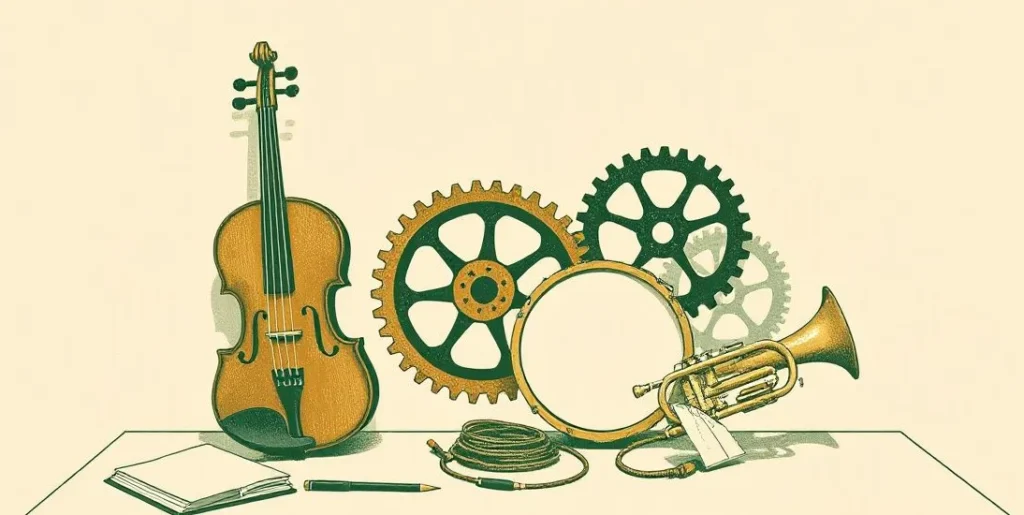
The most widely used metaphors for teamwork are a well-oiled machine, an orchestra, a sports team, a family, a ship’s crew (“we’re all in the same boat”) and pieces of a puzzle. Each one says something different about how a team works: a machine stresses efficiency, an orchestra stresses harmony under one leader, a crew stresses shared fate, and a family stresses loyalty.
That difference matters more than people expect. The metaphor a manager uses tends to carry a message about how people will be treated, and some of the most popular ones carry a message nobody meant to send. Below, the metaphors are grouped by what they emphasise, with example sentences, the hidden downsides, and help choosing one for a speech, a presentation or a class. For comparisons with like or as, see similes for teamwork.
Quick picker: what do you want the metaphor to say?
| To stress… | Use | Example |
|---|---|---|
| smooth, reliable work | a well-oiled machine | By March the support desk was a well-oiled machine. |
| different skills working together | an orchestra, a band | A good product team is an orchestra: design, code and sales all play their part. |
| clean handoffs | a relay race, passing the baton | The night shift passed the baton without dropping a single case. |
| shared risk | a crew, the same boat | If the launch fails, we’re all in the same boat. |
| everyone being needed | pieces of a puzzle, links in a chain | Each of you is a piece of this puzzle. |
| loyalty and care | a family, a band of brothers | The cast became a family over the long tour. |
| trust under pressure | roped together, in the trenches | We were in the trenches together during the merger. |
| growth over time | a garden, roots | A new team is a garden; it needs time before it gives you anything. |
Machine metaphors: efficiency and precision
- A well-oiled machine – a team that runs smoothly because everyone knows the routine. The kitchen staff worked like a well-oiled machine through the dinner rush. (With like, it becomes a simile; both forms are common.)
- Firing on all cylinders – every part of the team performing at full power. After the new hires settled in, the sales team was firing on all cylinders.
- Running like clockwork – work that happens exactly on schedule. Strictly a simile, but it belongs to the same family.
- The engine room – the part of a team that does the core work. The midfield is the engine room of this side.
- Moving parts – the pieces that all have to work at once. A wedding has a lot of moving parts, and the planner’s team kept every one of them turning.
The hidden message: machines do not have ideas, bad days or families. Praise a team as “a well-oiled machine” for one great week and nobody minds; describe your workplace that way in a recruiting video and some readers will hear “you are replaceable”.
Music metaphors: harmony and different skills
- An orchestra – specialists playing different parts of one piece under a conductor. It suits teams with a clear leader and clearly different roles. The hospital’s trauma team is an orchestra, and the lead surgeon is the conductor.
- A jazz band – a team that improvises around a shared tune; less hierarchy, more listening. Our research group is more jazz band than orchestra: anyone can take the solo.
- Playing in harmony / in sync – working together without friction.
- Singing from the same hymn sheet (mainly British) – saying the same thing in public. The American equivalent is on the same page, which comes from reading rather than music.
- Everyone plays their part – a quieter version of the orchestra image that works in almost any speech.
Sports metaphors: roles, plays and handoffs
- A team player – someone who puts the group’s result ahead of personal credit. It is so common that people forget it is a metaphor. (More options in other ways to say team player.)
- Passing the baton – from relay races: one person finishes a stage and hands the work on cleanly. Good for shift work, project phases and leadership changes.
- Dropping the ball – failing to do your part, so the whole team suffers. Someone dropped the ball on the booking, and forty guests had no rooms.
- Having someone’s back – covering for a teammate, as defenders do.
- A game plan – a shared strategy everyone understands before play starts.
- Rowing in the same direction – rowing is the purest team sport image: a boat only moves well when every oar enters the water together. Rowers have a word, “swing”, for the moment a crew moves as one.
The hidden message: sports metaphors suit competitive, goal-driven teams, but they assume a scoreboard. If your team supports patients or teaches children, “winning” can sound wrong.
Crew, climbing and military metaphors: shared fate
- We’re all in the same boat – everyone shares the same risk and the same outcome.
- All hands on deck – a sailing order: everyone stops what they are doing to help. It’s all hands on deck until the orders ship.
- Roped together – from mountaineering: climbers tied to one rope trust each other with their lives, and one fall affects everyone.
- In the trenches together – people who went through a hard stretch side by side. It suits looking back more than planning ahead.
- A band of brothers – from Shakespeare’s Henry V, in the speech before Agincourt: “We few, we happy few, we band of brothers”. It suggests a bond forged in a shared ordeal. “Band of brothers and sisters” is a common modern adjustment.
- Close ranks – soldiers moving together to leave no gap. Be careful: it now usually means a group protecting its members from criticism, which is rarely a compliment.
Puzzle, chain and building metaphors: everyone counts
- Pieces of a puzzle – no piece is the picture, but the picture is incomplete without any of them. A favourite for classrooms and team-building days.
- Links in a chain – from the proverb “a chain is only as strong as its weakest link”. It stresses dependence, and it can also point a finger, so use it about processes rather than people.
- The glue – the person who holds a team together, often without a title. Maria isn’t the manager, but she’s the glue on this team.
- Building blocks / pillars – the people or practices a team rests on. Trust and clear roles are the two pillars of this department.
- A kitchen brigade – the classic restaurant kitchen, organised by Auguste Escoffier into stations with a clear chain of command. It suits teams where speed depends on everyone knowing exactly whose job is whose.
Nature metaphors: growth and instinct
- A wolf pack – loyalty and coordination. Rudyard Kipling’s line from The Second Jungle Book is often quoted: “For the strength of the Pack is the Wolf, and the strength of the Wolf is the Pack.”
- A beehive / an ant colony – many small tasks adding up to something large. Note the downside: “hive mind” usually means people who have stopped thinking for themselves.
- Geese flying in a V – a popular motivational image: the lead bird takes the hardest position, then drops back while another takes a turn. It works best as a picture of shared leadership.
- A garden – a team that needs patience, care and time before it produces results. Good for new teams and for teachers.
- Roots – shared history that keeps a team steady. This team has deep roots; half of us joined in the same year.
Family metaphors: loyalty, with a warning
- We’re a family – the team cares about each other beyond the job.
- A home away from home – a team or workplace where people feel they belong.
- A work family / work spouse – colleagues who feel as close as relatives.
The hidden message: “we’re a family” is warm in a sports club or a small theatre company. In a business it can backfire, because families do not lay each other off, and the phrase is sometimes used to ask for unpaid loyalty: staying late, skipping holidays, not complaining. For most workplaces, “a team” or “a crew” is the safer choice; keep “family” for groups that truly behave like one.
Metaphors that sound positive but often are not
| Metaphor | What people mean | What listeners may hear |
|---|---|---|
| a cog in the machine | every role matters | you are small, unthinking and replaceable; this is how the phrase is usually used |
| hive mind | we think alike | nobody thinks for themselves |
| closing ranks | we stand together | we protect each other from criticism |
| we’re a family | we care about you | we expect sacrifices a job should not ask for |
| soldiers / troops | we are disciplined | orders come from above and are not questioned |
If you mean “every role matters”, say it with pieces of a puzzle or everyone plays their part instead of cog.
Choosing one for a speech, slide or classroom
- Pick one and stay with it. “We’re a well-oiled machine, so let’s row in the same direction and score some goals” mixes three images and makes listeners picture none of them. An extended metaphor – an orchestra through a whole speech: tuning up, rehearsal, the conductor, the performance – is far more memorable.
- Match it to the work. A relay race fits shift handovers; an orchestra fits a team of specialists; a crew fits a crisis; a garden fits a new team.
- For children: puzzle pieces, a sports team, a beehive and geese in a V are easy to picture and draw.
- For slogans: short familiar sayings work better than invented metaphors. “There’s no I in team”, “many hands make light work” and “two heads are better than one” are proverbs and sayings rather than metaphors, and you will find more in idioms for teamwork.
Practice
A. Choose the metaphor that fits best.
- The day nurses hand every patient’s notes to the night nurses at 7 p.m. sharp. (passing the baton / a beehive)
- A film crew with a director, camera operators, sound and lighting, each a specialist. (an orchestra / a wolf pack)
- The company may close, and every employee will be affected. (we’re all in the same boat / firing on all cylinders)
- Your manager wants to say that each person’s role matters, without making anyone feel small. (a cog in the machine / pieces of a puzzle)
B. What is wrong with this sentence? “Our team is a well-oiled machine that blossoms like a garden.”
C. Which of these is a simile, not a metaphor? the glue of the team / ran like clockwork / a band of brothers
Answers. A: 1 passing the baton; 2 an orchestra; 3 we’re all in the same boat; 4 pieces of a puzzle (cog suggests being replaceable). B: it mixes two images that pull against each other – machines do not grow; pick one. C: ran like clockwork, because it uses like.
Quick answers
What is a good metaphor for teamwork?
An orchestra is the most flexible: different skills, one piece of music, everyone listening to each other. For a short phrase, “a well-oiled machine” is the most common.
What is a metaphor for a team working well together?
“A well-oiled machine”, “firing on all cylinders”, “in sync” and “playing in harmony”.
Is “team player” a metaphor?
Yes. It borrows from sport to describe someone at work, though it is so familiar that most people no longer notice the image.
What is the difference between a teamwork metaphor and a teamwork idiom?
A metaphor says the team is something else (an orchestra). An idiom is a fixed phrase whose meaning you cannot work out from its words (“pull your weight”). Many teamwork phrases are both. Our guide to figurative language explains the terms.